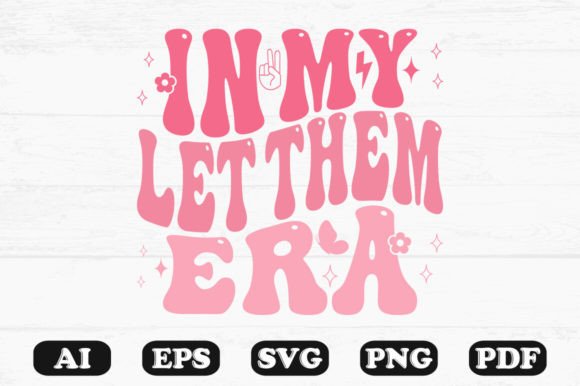
In My Let Them Era Retro Wavy SVG
First Impressions: A Confident, Playful Vibe That Lands Just Right
As someone who’s stitched hundreds of typography-based designs—from delicate nursery quotes to bold boutique tees—I opened In My Let Them Era Retro Wavy SVG expecting charm, but not quite this much personality. The wavy baseline isn’t just decorative; it’s kinetic. It gives the phrase a relaxed, self-assured sway—like a slow exhale after setting a boundary. Visually, it leans vintage without leaning into cliché: no excessive serifs, no forced distressing, just clean curves and balanced letter spacing that reads instantly at 3–4 inches wide. That matters—especially when you’re planning an embroidered tote bag for a local gift shop or stitching it onto a soft cotton baby onesie where clarity trumps cleverness.
Where This Design Truly Shines in Real Embroidery Projects
I tested In My Let Them Era Retro Wavy SVG across three real-use cases: a medium-weight canvas tote (for a small-batch artisanal coffee roaster), a French terry sweatshirt (custom order for a yoga instructor), and a linen tea towel (Etsy listing mockup). In each case, the design held up—not because it’s technically complex, but because its rhythm translates beautifully to stitch. The gentle wave allows satin-stitched letters to flow naturally, avoiding the stiffness that plagues rigid block fonts. On the tote, it sat comfortably in a 4×4 hoop with room to spare—ideal for craft business owners juggling multiple orders on tight timelines. On the sweatshirt, the curve helped the phrase follow the chest contour subtly, making it feel intentional rather than pasted-on. And on the tea towel? It added warmth without overwhelming the fabric’s texture—perfect for holiday embroidery or personalized kitchen gifts.
Smart Pairings for Your Craft Business
- Embroidered patch production: Its open letterforms and moderate height make it ideal for iron-on or sew-on patches—no tiny interior details to snag or distort.
- Tote bag design & apron branding: Works equally well centered on a pocket or scaled slightly larger across the front panel.
- Sweatshirt embroidery & custom apparel: Holds legibility even at 3.5" width—no blurring or thread piling in the curves.
- Baby embroidery & nursery decor: Soft enough for onesies and burp cloths, especially in muted thread palettes (think oatmeal + sage or heather gray + blush).
Where to Proceed With Thoughtful Stitching
This isn’t a one-size-fits-all embroidery file—and that’s a strength, not a limitation. Because In My Let Them Era Retro Wavy SVG relies on fluid shape and visual balance, it asks for intentionality in execution. Avoid cramming it into a 3×3 hoop unless you’re willing to simplify stroke weight or reduce overall size—tiny waves lose their charm when compressed. On stretchy fabrics like knits or thin jersey, stabilize generously: a cutaway + tear-away combo prevents waviness from fighting against fabric give. Dark fabrics demand high-contrast thread—avoid light grays or creams unless you’re adding an underlay stitch layer. And curved surfaces like caps? Test first: the outermost letters may need slight manual adjustment in your embroidery software to maintain even tension.
What It Adds—And What It Doesn’t Promise
Using In My Let Them Era Retro Wavy SVG elevates handmade product perception instantly. Customers recognize confidence in cursive-leaning typography, and the retro-but-not-dated vibe bridges generations—it feels equally at home on a Gen Z-owned Etsy shop and a mom-run boutique selling holiday embroidery. It builds trust because it looks *designed*, not generated. That matters for Etsy sellers and small shop owners: buyers pay more for perceived craftsmanship, and this design delivers that quietly. It doesn’t promise technical fireworks—no intricate fill stitches or layered applique—but it doesn’t need to. Its value is in clarity, mood, and wearability. As a digital embroidery file, it supports strong printable mockups and consistent branding across social media, packaging, and product tags.
Practical Designer Notes Before You Stitch
- Always test on scrap fabric—especially if using textured weaves or blends. The wave’s smoothness can catch on nubs or pile.
- Review stitch density in your editing software. If the original file lacks underlay or pull compensation, add it for smoother satin stitch flow along the curve.
- Confirm licensing terms before selling finished products or bundling it as part of a commercial embroidery collection. Since it’s listed under Graphics and Crafts, verify whether personal use, small business use, or extended commercial rights apply.
- Check thread color contrast on both light and dark backgrounds—not just digitally, but in physical swatches. What looks balanced on screen may vanish on charcoal fleece.
- Use proper stabilizer: medium-weight cutaway for stable fabrics, lightweight tear-away for linens, and fused + cutaway for knits.
- Inspect small details—especially the connection points where letters meet the wave. Some SVG-to-embroidery conversions leave micro-gaps or overlapping nodes.
- Test black-and-white mockups to assess silhouette strength. This design should read clearly even without color context.
A Final Thought for Makers Who Value Both Heart and Precision
In My Let Them Era Retro Wavy SVG isn’t flashy—but then again, the best design assets rarely are. It’s the kind of embroidery file that works quietly in the background of your craft business: supporting your brand voice, resonating with customers who appreciate wit and warmth, and stitching cleanly across dozens of product types. Whether you're prepping holiday embroidery for a local market, building an Etsy seller portfolio, or designing custom apparel for a client who wants to say something meaningful without shouting—it lands. Just remember: great embroidery starts with thoughtful selection, not just beautiful files. So take the time. Test it. Trust your eye. And let the wave carry your work forward—with ease.